
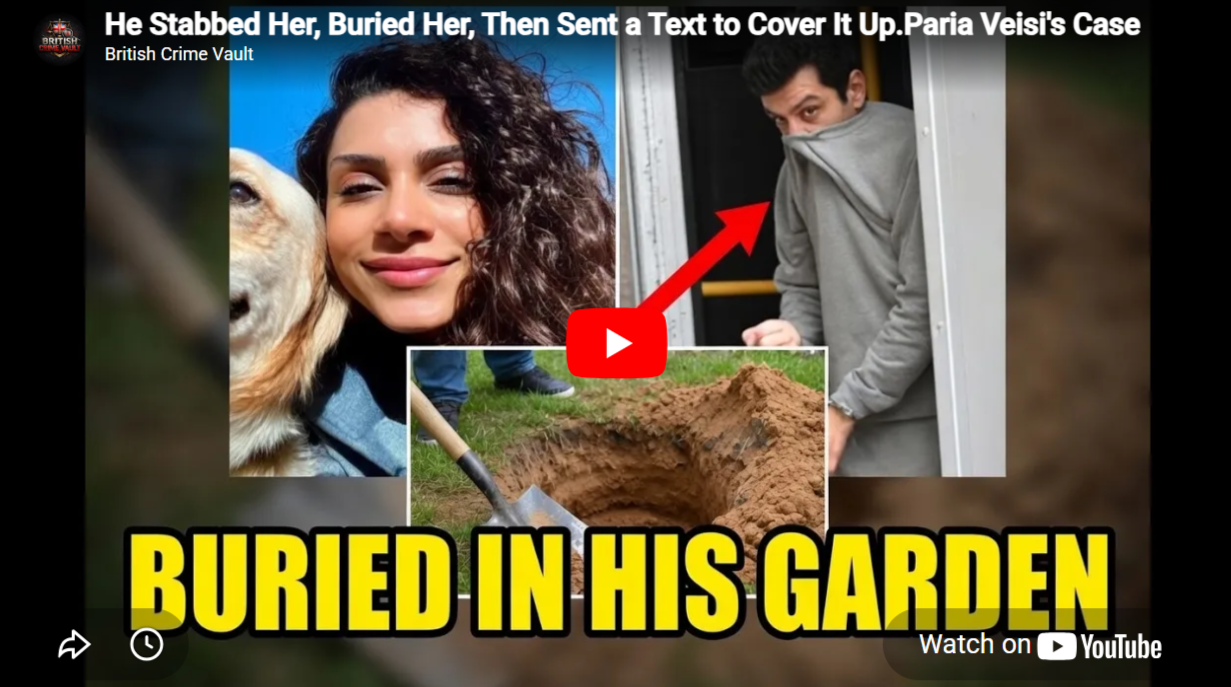
In the quiet suburbs of Cardiff, a single text message lit up a phone screen and shattered a family’s world: “I’m going back to Iran for a while. Phone off for a month or two. Don’t worry.” It was April 2025, and Paria Veisi’s friends and colleagues breathed a sigh of relief at first—maybe she needed space after her messy separation. But Paria wasn’t on a plane to Tehran. She was already dead, her blood still warm on the conservatory floor of her former home, her body dragged across the lawn and shoved into a shallow grave where a pond used to sparkle. Her estranged husband, Alireza Askari, had just stabbed her four times in the neck and chest, then spent the next days planting flowers over her corpse while impersonating her online. What followed was one of the most cold-blooded cover-ups Wales had ever seen—a story of obsession, betrayal, and a killer who would rather destroy the woman he claimed to love than let her walk away.
Paria Veisi had arrived in the UK from Iran in 2010, chasing a life far from the constraints of her homeland. At 37, she was a vibrant hairdresser with a client list full of loyal regulars who adored her warm smile, her skilled hands, and the way she could turn a bad day around with a quick chat about life. She was the kind of woman who remembered your last haircut details and asked about your kids by name. Friends described her as compassionate, full of life, the “dearest and most innocent” member of her family back in Iran. She had built something real in Cardiff: a flat she rented after leaving her marriage, a black Mercedes GLS she drove with pride, and dreams of a fresh start unburdened by fear. But that fear had been her shadow for years. Her marriage to Alireza Askari, 42, had soured long before the final split. What started as a union between two Iranian expats—him working odd jobs, her building her salon career—had twisted into control, arguments that echoed through the walls of their Penylan home on Foster Drive, and whispers of abuse that Paria confided only to her closest circle. She was scared of him, friends later told police. She had moved out less than two weeks before her death, renting a new place in Cathays and telling loved ones she finally felt free.
Alireza wasn’t ready to let go. Far from it. He had been plotting in the shadows for at least a month. While Paria packed her things and started over, he was texting a girlfriend back in Iran, confessing his twisted plan to “remove” his wife so they could be together without complications. The girlfriend tried to talk him down, but Alireza’s mind was made up. He didn’t want a divorce. He didn’t want Paria thriving without him. He wanted her gone—permanently. On April 12, 2025, he put his plan into motion with chilling efficiency. That morning, he drove to a local supermarket and bought a pack of kitchen knives. He didn’t need them for cooking. He selected the smaller one as his weapon of choice, slipping it into his pocket like it was just another errand. Paria had no idea what awaited her when she agreed to stop by the old house that afternoon. Maybe to pick up some belongings, maybe for one last civil conversation. She left work in Canton around 3 p.m., excited about her new chapter, her Mercedes humming along the familiar roads toward Penylan.
She pulled up at 4:23 p.m. The house looked ordinary from the street—neat garden, conservatory catching the late spring light. But inside, Alireza was waiting. Within minutes of her stepping through the door, he attacked. The murder happened in the conservatory, swift and merciless. Paria was taken completely by surprise—no defensive wounds on her hands, no time to fight back or run. He stabbed her four times in the neck and upper chest, the blade slicing deep. Two slash wounds added to the horror. Blood sprayed across the tiles as she collapsed. The post-mortem would later confirm the smaller knife from that supermarket pack did the job; the larger ones were never even needed. Alireza didn’t panic. He didn’t call for help. At 4:28 p.m., just five minutes after the killing, he dialed his aunt, Maryam Delavary, in London. “Come now,” he told her. She booked a taxi from Shepherd’s Bush and raced to Cardiff, knowing—or so she later claimed—only that her nephew needed “help coping” after Paria left.
But Alireza had already moved to phase two: erasure. He changed out of his bloody clothes, drove to a nearby leisure centre, showered, and even swam laps in the public pool to wash away any trace evidence. On the way back, he stopped for strong bleach, dusters, and a jet washer. He scrubbed the conservatory floor until his arms ached, blasting away the crimson stains. Paria’s blood still soaked into the hairdressing equipment she’d left behind—tools from her salon life that he later paid a waste disposal firm to haul away. Then he turned to the garden. There used to be a pond out back, a peaceful feature now drained and forgotten. He dragged Paria’s body across the lawn, dug a makeshift grave in the soft earth where the water once pooled, and shoved her in. He covered her with soil, patio slabs, and fresh plants—bright flowers that would bloom mockingly over her remains. It was grotesque, calculated. He even texted from her phone to her boss: she’s heading to Iran for medical reasons, phone off soon. To family too. “Don’t worry.” The messages bought him time.
Maryam arrived the next day, April 13. The 48-year-old from White City’s estate didn’t hesitate. Court would later hear she was “hand in glove” with her nephew. Together, they refined the grave, layering more dirt and blooms to make the garden look untouched. Alireza wasn’t done planning. On April 14, he texted his Iran girlfriend again, brainstorming chemicals to dissolve the body completely—caustic soda, acid, anything to leave no trace. He scouted remote spots in the Brecon Beacons on CCTV footage, driving near the Storey Arms to find a secondary dump site. The next day, he drove all the way to Birmingham, loading his car with canisters of caustic soda. If police had been slower, Paria’s remains might have vanished forever, chemically erased in some lonely Welsh hillside.
But Paria had people who cared. A concerned friend noticed the odd texts and the sudden silence. No financial activity on her cards. Her black Mercedes hadn’t moved. On April 13, police knocked on the door at Foster Drive for a welfare check. Alireza and Maryam played their parts perfectly—calm, confused. “She left for Iran,” they said. “She has a boyfriend there.” Alireza even described Paria as his “carer” instead of his estranged wife, spinning lies with a straight face. The officers left, but South Wales Police didn’t stop digging. By April 15, with no proof of life and mounting suspicions, they returned in force. Alireza was arrested on the M4, heading back from Birmingham with those chemical canisters in the boot. He denied everything at first, claiming ignorance. But forensics told a different story. Blood in the conservatory. Blood on the discarded equipment. The disturbed garden soil. Detectives lifted the slabs and flowers, and there she was—Paria, buried like forgotten refuse after just seven days.
The arrest cracked the case wide open. Alireza was charged with murder, preventing a lawful burial, and assault occasioning actual bodily harm. Maryam faced charges for perverting the course of justice and helping conceal the body. In January 2026, at Cardiff Crown Court, Alireza finally admitted the full horror: he pleaded guilty to murder. His initial defense had toyed with manslaughter, citing a “diagnosed schizophrenia” and voices he claimed to hear upon arrest. He said the voices told him to do it. But prosecutors and the judge saw through it. The planning—the knife purchase, the texts to his girlfriend, the bleach runs, the chemical shopping—screamed premeditation, not delusion. Mrs Justice Stacey would later slam the claim as cynical, noting it only stigmatized real mental health struggles. “You would clearly rather kill her than have her leave you,” she told him.
The two-day sentencing hearing in March 2026 laid bare the devastation. Prosecutor William Hughes KC painted the picture: a vulnerable woman, ambushed in the home she once shared, her future stolen in minutes. Alireza had done “everything in his power” to cover up the cold-blooded act. His aunt had been a willing participant, not some innocent bystander. Defense lawyers pleaded for leniency on mental health grounds, but the evidence overwhelmed them. Paria’s sister, Heliya Veisi, stood in court and read a victim impact statement that left the public gallery in tears. “Today’s verdict will never bring Paria back to us, nor can it heal the deep and lasting pain of her loss,” she said, voice breaking. “Paria was not just a victim—she was a beloved mother, daughter, sister, and friend, who was kind, full of life, and deeply loved. Her memory will forever remain in our hearts, and the pain of losing her is a wound that time will never fully heal.” She recalled their last video call, praising how beautiful Paria’s hair looked, never imagining it would be the final time she’d see her sister’s face or hear her voice. The family back in Iran was shattered. Detective Chief Inspector Matt Powell echoed the grief: Paria was “much-loved,” popular with everyone, including her clients. “She will be sorely missed by everyone.”
On March 13, 2026, Mrs Justice Stacey delivered the sentence. Alireza Askari received life imprisonment with a minimum term of 26 years—25 years and 37 days, to be precise—for the murder. The judge called it a “cold-blooded” killing of a woman in the prime of her life, her death destroying her family’s happiness. Maryam Delavary got five years and six months for her role in the cover-up. As the gavel fell, Paria’s loved ones felt a sliver of justice, but nothing could fill the void. The garden on Foster Drive, once a crime scene, stood as a silent monument to what obsession can do.
This wasn’t a crime of passion in the heat of the moment. It was calculated, rehearsed, and executed with the precision of someone who had decided his wife’s independence was a death sentence. Alireza had texted about destroying her body with chemicals just days after the killing, as if she were waste to be chemically dissolved. He swam laps while her blood dried on the floor. He planted flowers over her grave like it was a weekend DIY project. And through it all, he impersonated her—stealing her voice from beyond the grave to buy himself time. Paria had escaped the marriage physically, but she couldn’t outrun his rage. She had confided in friends about the fear, the control, the moments she felt trapped. Her new flat in Cathays was supposed to be her sanctuary. Instead, it became the place she left one final time, driving toward the man who would end her.
In the weeks after the sentencing, Cardiff’s Iranian community and Paria’s clients mourned quietly. Tributes poured in—flowers at the salon where she worked, messages online remembering her laugh, her kindness. South Wales Police praised the family’s bravery and the community’s support during those tense early days when suspicion hung over Penylan. The case highlighted the hidden dangers in domestic breakdowns, the way control can escalate when a partner chooses freedom. Alireza’s aunt returned to London in disgrace, her family ties severed by her choices. He sits in prison now, staring down decades behind bars, his claims of voices dismissed as the desperate excuses of a man who chose murder over divorce.
Paria’s story lingers because it was so ordinary at its core. A marriage ending. A woman rebuilding. A man who couldn’t accept it. Yet the brutality—the conservatory ambush, the garden burial, the fake texts—turned it into something monstrous. Her sister spoke of irreversible suffering, a broken heart words can’t describe. For Paria’s family, justice came too late. She was 37, full of potential, her hair always perfect, her smile lighting up rooms. Now, her legacy is a warning: sometimes the person you once trusted most is the one you should fear the most. In Cardiff’s suburbs, that garden on Foster Drive grows flowers still, but beneath them lies the truth no amount of bleach or soil could ever hide. Paria Veisi didn’t go to Iran. She was taken there by force—in death—by the man who refused to let her live without him. And for that, Alireza Askari will pay with the rest of his life.


Leave a Reply