
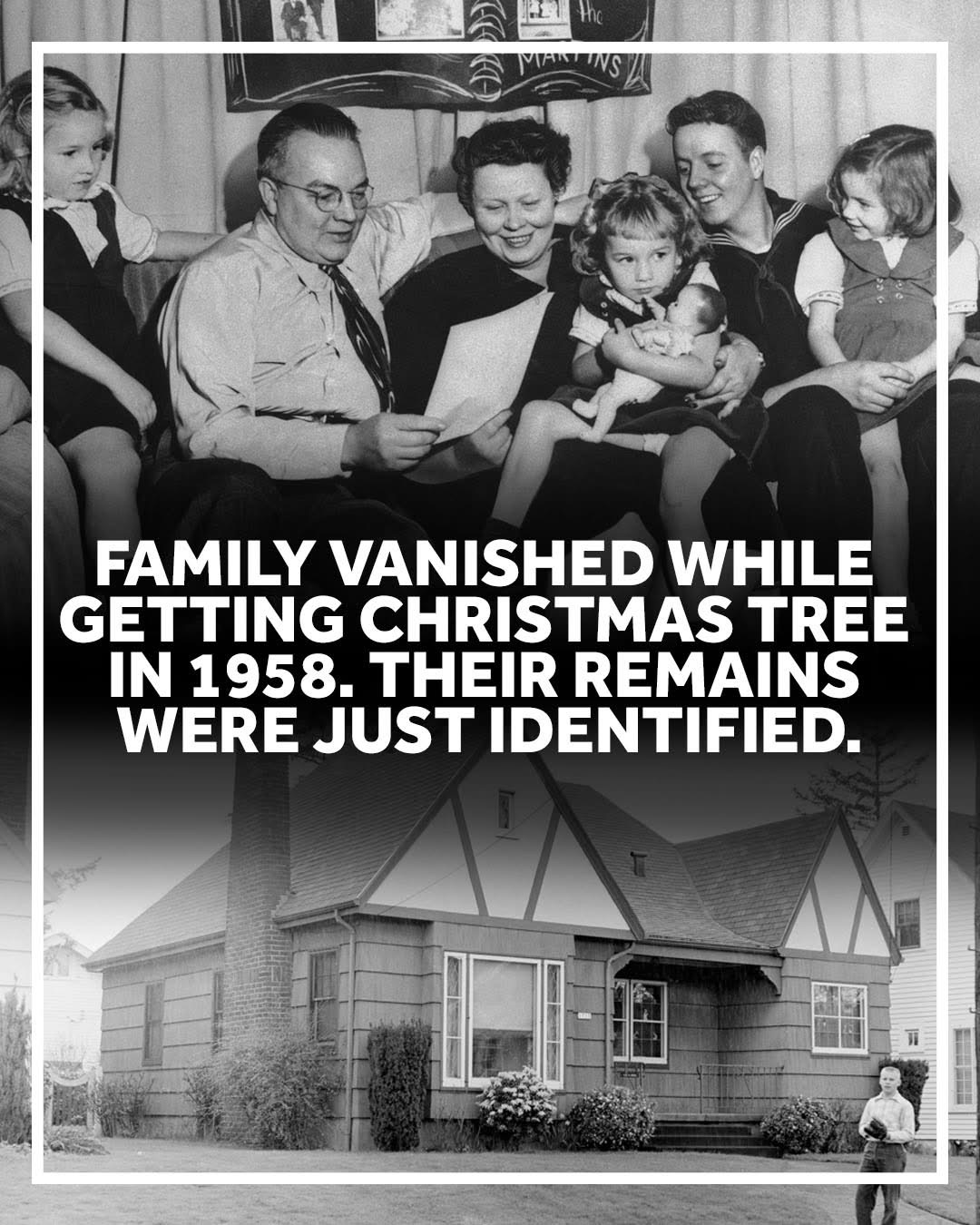
The Martin family disappearance is one of those haunting cold cases that lingered in the American imagination for decades. In 1958, a Portland, Oregon, family of five set out on what should have been a simple, joyful pre-Christmas outing to gather greenery and a tree for the holidays. They never returned home. Their station wagon vanished along with them, sparking a massive search, national headlines, and endless speculation about foul play. Nearly 68 years later, in April 2026, science and persistence finally brought closure.
A Normal Day Turns Mysterious
Kenneth Martin, 54, and his wife Barbara Martin, 48, lived with their three daughters in the Roseway neighborhood of Northeast Portland at 1715 N.E. 56th Avenue. The couple had attended a Christmas party the night before. On the morning of Sunday, December 7, 1958, they loaded their daughters—Barbara “Barbie” (14), Virginia (13), and Susan (11)—into their 1954 cream-and-red Ford Country Squire station wagon and headed east into the scenic Columbia River Gorge. Their plan was straightforward: collect holly, fir boughs, and perhaps a Christmas tree to make festive wreaths and decorations back home.
They were last reliably seen in the afternoon. Around 4 p.m., they stopped for gas at Dean Baxter’s station in Cascade Locks, buying about five gallons. Later, they were spotted at the Paradise Snack Bar in Hood River, where a waitress served them. Witnesses reported seeing the family on the north bank of the Columbia River in Washington state as dusk fell. Kenneth wore a tan zip-up jacket and dark slacks; Barbara had on a navy blue coat over a plaid jacket and black print dress; Barbie wore jeans with rolled cuffs and a beige coat. After that, the trail went cold. The family simply disappeared.
When they didn’t return that evening, concern grew. Their home was found undisturbed the next day—laundry still in the machine, dishes from the previous night drying on the rack, and plenty of money left in the bank. No signs of struggle or hasty departure. The car was gone too.
The disappearance triggered one of Oregon’s largest manhunts at the time. Police, volunteers, and even the U.S. Army Corps of Engineers lowered the river level behind Bonneville Dam by five feet and used sonar in hopes of spotting the wagon. Searches extended to Mount Hood and surrounding areas, but nothing turned up immediately.
Then, in May 1959, tragedy compounded the mystery. Susan Martin’s body was found on the north bank of the Columbia River near Camas, Washington—about 70 miles downstream from where the family was last seen. The next day, Virginia’s body surfaced near Bonneville Dam. Both were confirmed by dental records and ruled deaths by drowning. No gunshot wounds or obvious signs of violence were noted in the autopsies, though some metal traces (including aluminum) were found on Susan’s clothing. The bodies were roughly 30 miles apart.
Kenneth, Barbara, and Barbie remained missing, along with the station wagon. A stolen 1951 Chevrolet found nearby with a bloody handgun added fuel to speculation, but no solid link was ever proven. Tire tracks leading off a cliff near The Dalles and other fragmentary clues led some investigators to suspect the car had plunged into the river—perhaps accidentally, perhaps not. A $1,000 reward was offered, and theories ranged from a tragic accident to abduction or even more sinister foul play. The case drew national attention, with one 1959 Associated Press story asking poignantly: “Where do you search if you’ve already searched every place logic and fragmentary clues would suggest?”
Over the years, the mystery endured. The family’s eldest son, Donald (then 28 and studying in New York), eventually inherited the estate. Sightings and tips trickled in but led nowhere. By the 21st century, the case had faded into Oregon lore, one of those unsolved vanishings that refused to be forgotten.
Enter Archer Mayo, an experienced rescue and recreation diver from the area. Obsessed with the case for years (he reportedly began seriously investigating around 2018), Mayo used historical photos of the Cascade Locks from the late 1800s to pinpoint a likely “pit” in the riverbed where a car might have settled and been buried under decades of silt, rock, and debris. He made multiple solo dives, even building his own mini-dredge vacuum to clear sediment.
In late 2024 (November, by some accounts), Mayo located what appeared to be the Martin family’s Ford station wagon upside-down, about 50 feet underwater near Cascade Locks—buried under mud, salmon remains, mussel shells, and silt. Official recovery efforts began in March 2025, when a crane lifted parts of the vehicle. Due to heavy encrustation, only the chassis, rear axle, engine, and some components could be retrieved initially and sent for lab analysis. Those confirmed it matched the Martin wagon.
Mayo continued diving. In August 2025, he recovered human remains from inside the wreckage, along with poignant artifacts—including a camera case with Kenneth Martin’s name and address still legible. Other items like clothing remnants surfaced too. The discoveries electrified those familiar with the case.
DNA Brings Final Answers
In late 2025, the Hood River County Sheriff’s Office and Oregon State Medical Examiner’s Office submitted the skeletal remains to Othram, Inc., a specialized forensic genetics lab in Texas. Using advanced Forensic-Grade Genome Sequencing, scientists generated a detailed SNP profile from the long-submerged bones. This was compared against a reference sample from a living relative using kinship testing. The results were conclusive: the remains belonged to Kenneth Martin. Based on the context and circumstances, authorities also identified Barbara Martin and their daughter Barbie.
On April 16, 2026, the Oregon State Medical Examiner’s Office made the announcement. The Hood River County Sheriff’s Office officially closed the investigation, stating there was no evidence of a crime. The most likely explanation is a tragic accident: the family’s station wagon left the road and plunged into the Columbia River, where it remained hidden for nearly seven decades. The two younger daughters’ bodies had apparently floated free earlier, while the others stayed with the vehicle.
Closure After Nearly 70 Years
The Martin family’s story is a reminder of how the past can stay submerged—literally and figuratively—until technology, determination, and a bit of luck align. What began as a wholesome holiday errand ended in heartbreak, but the resolution brings peace to descendants and puts to rest decades of speculation. No more wondering if foul play claimed them or if they simply vanished into thin air.
Archer Mayo’s relentless solo efforts stand out as a testament to citizen persistence in cold cases. Without his dives into “The Pit,” the car—and the answers—might have stayed buried forever.
For those who followed the case over the years, the ending is bittersweet. The family is no longer missing. They were together, as they had been that December day, on what should have been a happy outing. The Columbia River finally gave up its secret.



Leave a Reply